
When the Region Shakes, Does India's Market Hold?
What history tells GCC-based NRIs about staying invested through globlal conflict
If you live in the Gulf and you're following the news these days, you're no stranger to uncertainty. The ongoing Iran–Israel–US tensions have cast a long shadow across the region, and many NRIs in the UAE, Saudi Arabia, Qatar, Kuwait, Bahrain, and Oman are watching closely, both for their safety and for their savings.
A natural question arises: Should I pull my money out of Indian markets until this blows over?
History, it turns out, has a very clear answer, and it may surprise you.
"Every major crisis felt like the right moment to exit the market. Every time, staying invested was the right call."
The Evidence: India's Market Has Seen This Before
Indian capital markets have lived through wars, terror attacks, and geopolitical shocks that rattled investors worldwide. From the Kargil War in 1999 to the Lehman Brothers collapse and 26/11 Mumbai attacks in 2008 to the Pulwama crisis in 2019. Each event triggered fear, headlines, and short-term volatility. And each time, the Nifty 50 not only recovered but delivered remarkable long-term returns.
Here's what the numbers show (source: NSE, data as of 27 Feb 2026):
Year | Crisis Event | 1-Year CAGR | 3-Year CAGR | 5-Year CAGR |
1999 | Kargil War | 35.6% | 4.2% | 12.7% |
2001 | 9/11 Attack | −2.1% | 17.7% | 26.9% |
2001 | Indian Parliament Attack | −1.1% | 21.8% | 27.9% |
2003 | Iraq War Invasion | 68.3% | 47.1% | 34.9% |
2008 | Lehman Brothers + 26/11 Mumbai Attack | 81.9% | 19.6% | 17.1% |
2019 | Pulwama Attack | 12.7% | 16.2% | 15.2% |
2022 | Russia–Ukraine War | 7.5% | 11.6% | Data pending |
2026 | Iran–Israel–US Conflict | Unfolding | N/A | N/A |
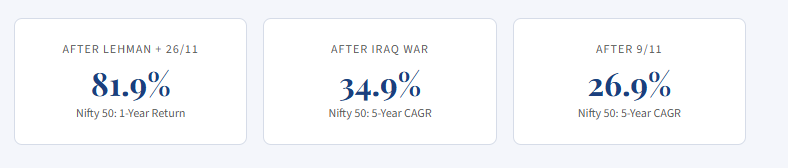
Even in the worst short-term dips, such as after 9/11 and the Parliament attack, the 3-year and 5-year CAGR figures painted a very different story. Investors who stayed the course were rewarded handsomely. The Iraq War year of 2003 produced a staggering 68.3% one-year return and a 34.9% five-year CAGR. After the twin shocks of the Lehman Brothers collapse and the 26/11 attacks in 2008, the market rebounded with an extraordinary 81.9% gain over the following year.
A Word for NRIs Watching West Asia Right Now
For those of you based in the UAE, Saudi Arabia, Kuwait, or elsewhere in the Gulf, the current Iran–Israel–US tensions likely feel closer to home than they do for someone sitting in Bengaluru or Mumbai. You're living and working in the region where the conflict is unfolding, and the anxiety is real and understandable.
But here's an important distinction: geopolitical volatility in West Asia does not directly impair India's economic fundamentals. India has deep trade ties across the Gulf, and while oil price spikes can affect inflation and fiscal dynamics, the Indian economy has shown a robust ability to adapt. The rupee may wobble. The indices may dip. But the long-term growth trajectory of the Indian economy, driven by demographics, domestic consumption and structural reforms, remains intact.
A Note Specifically for GCC-Based NRIs
You have an edge that resident Indians do not: you're likely earning in a hard currency (AED, SAR, QAR, KWD) while your Indian investments benefit from rupee-denominated compounding. When global crises cause short-term market dips, you are actually in a position to invest more at lower valuations, turning volatility into opportunity. For NRIs with SIPs or lump-sum strategies in Indian mutual funds, this moment may be precisely the time to top up, not to exit.
The Current Picture: 18 Months of Consolidation
Adding another layer of context: Indian markets have been broadly flat for the last 18 months. For the casual observer, that might feel like stagnation. But for the patient investor, history reveals a compelling pattern: extended consolidation phases in Indian markets have consistently been followed by strong rallies.
Consolidation Period | Duration | Following Year | 1-Year Return Post-Consolidation |
Jan 2013 – Mar 2014 | 14 months | Mar 2014 – Mar 2015 | 45.4% |
Jul 2015 – Feb 2017 | 18 months | Feb 2017 – Feb 2018 | 28.3% |
Oct 2021 – Dec 2022 | 14 months | Dec 2022 – Dec 2023 | 15.8% |
Current Phase | ~18 months | N/A | Unfolding |
Source: Niftyindices.com
Three prior consolidation phases, each lasting 14 to 18 months, delivered between 15.8% and 45.4% returns in the year immediately following. We are now in a consolidation of comparable length. If history rhymes, the market may be coiling for its next leg up.
Flat markets are not broken markets. They are often markets catching their breath before the next ascent.
What Should You Do Right Now?
The instinct in times of crisis is to act: to do something, to move money to safety. But the data consistently shows that the most costly investment decisions are made in moments of peak fear. Here's a practical framework:

The Bigger Picture
Every generation of Indian investors has faced a moment that felt like "this time is different." The Kargil War. The dot-com bust. Lehman Brothers. 26/11. COVID-19. Each time, staying invested, rather than retreating to the sidelines, proved to be the right decision over any meaningful time horizon.
For NRIs in the GCC, the current environment carries an added emotional weight: you're physically close to a conflict that the rest of the world reads about on their phones. But your financial decisions need not be driven by geography or anxiety. India's market has a 25-year track record of absorbing shocks and compounding wealth for those who chose patience over panic.
The current moment, a geopolitical flare-up layered on top of an 18-month consolidation, looks historically, like an opportunity in disguise.
Historically, staying invested has turned crisis-driven volatility into strong long-term gains.


Comments